
And how to get it right when change is unavoidable
Organizational design is rarely something companies proactively plan for. More often, it becomes relevant when something breaks, grows too fast, or fundamentally changes. Yet time and again, we see that organizational design is one of the most powerful – and underestimated – levers for turning strategy into execution.
In many cases, organizations struggle not because their strategy is wrong, but because their structure makes execution unnecessarily difficult.
When organizational change is needed
There are typically a few situations where organizational design moves from a “nice to have” to a necessity.
Structural change events are the most obvious trigger. Mergers, acquisitions, integrations, carve-outs, and rapid international expansion all introduce new interfaces, overlapping responsibilities, and unclear decision rights. Without deliberate design choices, complexity tends to accumulate faster than performance.
Another common trigger is persistent execution problems. Leadership teams often recognize the symptoms: decisions pile up at the top, accountability is unclear, handovers multiply, and initiatives stall despite strong effort. Over time, workarounds become the norm, and frustration grows.
Cost and efficiency pressure is a third driver. Margin erosion or profitability challenges frequently reveal organizations that have grown layers, roles, and coordination mechanisms without ever removing anything. The result is management attention spread too thin across too many priorities.
Finally, organizational redesign can be a conscious strategic move. When a company adopts a new strategy, enters a new phase, or wants to build fresh momentum, deliberately “rocking the boat” can help reset focus, clarify ownership, and signal change.
Across all these situations, the common theme is the same: the existing organization no longer supports what the business needs to achieve next.
What good organizational design actually means
Organizational design is often reduced to boxes and reporting lines. In reality, structure is only the visible outcome of a much deeper set of choices.
At its core, good organizational design answers three fundamental questions. Where are decisions made? Who owns outcomes end-to-end? And how does work flow through the organization with minimal friction?
Effective design always starts with strategy. The organization should reflect where value is created, which capabilities are critical, and where leadership attention matters most. This leads to deliberate choices around the operating model, such as functional versus divisional structures, the degree of centralization, and how much autonomy business units truly have.
Equally important are accountability and interface design. Clear ownership, explicit handovers, and well-defined decision rights reduce the need for escalation and coordination overhead. Management structure, including layers and spans of control, must be realistic in terms of what leaders can actually handle.
In this sense, the org chart is the result – not the starting point – of organizational design.
Why organizational redesigns often fail
Despite good intentions, many organizational redesigns fall short of their objectives.
A common pitfall is designing structure in isolation. Boxes change, but ways of working, governance, and decision forums remain the same. The organization looks different, but behaves exactly as before.
Another frequent issue is overloading management bandwidth. New roles, committees, and processes are added without removing existing ones. Leaders are expected to do more with the same time, resulting in slower decisions rather than better ones.
Many organizations also avoid the hard choices. Ambiguity is often preserved to keep stakeholders comfortable, but unclear ownership quickly becomes a source of conflict and inefficiency.
Finally, transitions are underestimated. The old organization typically disappears faster than the new one becomes effective. Without a clear transition plan, productivity dips, confidence erodes, and informal power structures fill the gap.
The outcome is an organization that feels more complex and less effective than before the change.
How Spring approaches organizational design
Spring’s approach to organizational design is grounded in execution realism. The objective is not to create a theoretically perfect structure, but one that works in practice from day one.
This typically starts with linking design choices directly to strategic priorities and value drivers. Clear design principles are established early to guide decisions consistently across the organization.
Special attention is paid to management capacity and leadership behaviour. Structures are assessed not only on paper, but against what leaders can realistically run, decide, and communicate.
Organizational design is also paired with transition planning. Phasing, early proof points, and clarity on decision rights during the transition help organizations maintain momentum while change is underway.
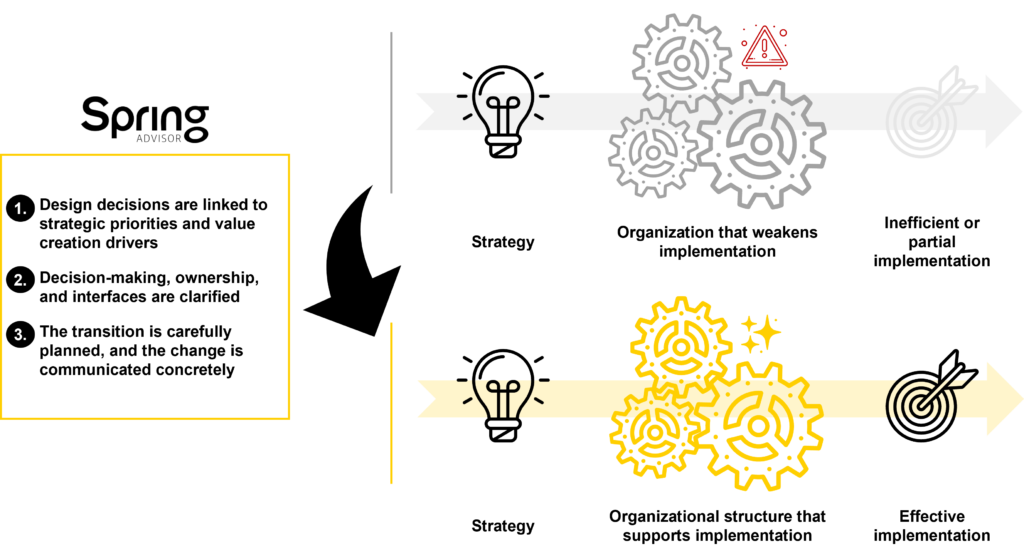
Communication as a critical success factor
Even a well-designed organization will fail if it is not communicated effectively.
In most organizational redesigns, communication is underestimated. Employees rarely resist change because of the structure itself. They resist uncertainty, perceived loss of role clarity, and lack of understanding of why change is happening.
Successful org changes therefore require clear, consistent, and repeated communication. Leaders must be aligned on the rationale, the intended outcomes, and what the change means in practice for different parts of the organization. Messages need to be tailored, timed, and reinforced across multiple channels.
Spring supports clients not only in designing the organization, but also in shaping the change narrative. This includes leadership messaging, management toolkits, and communication materials that help translate structural decisions into everyday understanding. Done well, communication builds trust, reduces noise, and accelerates adoption of the new model.
Where this has delivered impact
Over the past years, Spring has supported organizational design work in a variety of contexts.
This includes post-merger integrations, where early clarity on accountability and decision rights helped prevent operational slowdown. It also includes growth-driven redesigns, where scalable structures were introduced without adding unnecessary layers. In turnaround and performance improvement situations, simplification of structures and sharper leadership focus played a key role in restoring profitability.
In each case, organizational design was treated as a means to accelerate strategy — not as an isolated organizational exercise.
Closing thought
Organizational design is one of the few levers that simultaneously affects strategy, people, and performance. When done well, it becomes a competitive advantage. When neglected, it quietly undermines execution every day.
For organizations facing change, the question is rarely whether organizational redesign is needed. The real question is how deliberately and thoughtfully it is done.
When organizational complexity starts to slow execution, structure becomes a strategic question. Spring helps organizations make deliberate design choices and implement them with clarity — ensuring the organization supports what the business needs to achieve next.